


Research group led by Jiangfeng Du has made significant experimental progress in non-Hermitian physics using a single-spin system. They reported the experimental observations of a non-Hermitian non-Abelian topological transition and a new type of exceptional point—the Dirac exceptional point. These two works were published in Nature Nanotechnology and Physical Review Letters with the titles "Non-Hermitian non-Abelian topological transition in the S=1 electron spin system of a nitrogen vacancy centre in diamond" and "Experimental observation of Dirac exceptional points", respectively.
Non-Hermitian systems exhibit a series of unique and novel phenomena and have profound research value in areas such as quantum control and topological physics. Recent theoretical studies have shown that multi-level non-Hermitian systems can host various types of exceptional points and rich non-Abelian topological phenomena. These phenomena reveal the mechanism of the interplay between exceptional points, which is the basis for numerous applications in non-Hermitian physics. However, due to the extreme challenge of achieving high-precision, high-degree-of-freedom control of quantum states in multi-level non-Hermitian systems, many important non-Abelian topological phenomena and new type of exceptional points had not been experimentally observed until now.
The research group has conducted a series of experimental studies on non-Hermitian physics based on a single-spin system in recent years. They developed a universal method for realizing non-Hermitian Hamiltonians [Science 364, 878 (2019)], observed the chiral mode switching phenomenon in a two-level non-Hermitian system [Physical Review Letters 126, 170506 (2021)], and further advanced non-Hermitian physics research into three-level systems, achieving the observation of a third-order exceptional line [Nature Nanotechnology 19, 160 (2024)]. These works provided the foundation for the two recent achievements.
The first achievement, conducted in collaboration with Researcher Haiping Hu from the Institute of Physics, Chinese Academy of Sciences, focused on the non-Hermitian non-Abelian topological transition and realized its first experimental observation in a single-spin system. The experimental results show that the interplay between different types of exceptional points leads to a non-Abelian topological transition. Before and after the topological transition occurs, the topological structure of the energy spectrum changes. The conventional Abelian topological charge, which usually characterizes the system's topological properties, remains unchanged; whereas a non-Abelian topological invariant—the eigenvalue braid—undergoes a change. This implies such topological transition cannot be characterized by the Abelian topological charge, but the non-Abelian braiding invariant can completely describe the process. Furthermore, the research group observed a novel phenomenon: after the topological transition, a pair of second-order exceptional points with opposite topological charges did not annihilate upon collision but instead generated a third-order exceptional point. The experimental results demonstrate the important impact of the non-Abelian topological transition on the energy spectrum structure and the properties of exceptional points.
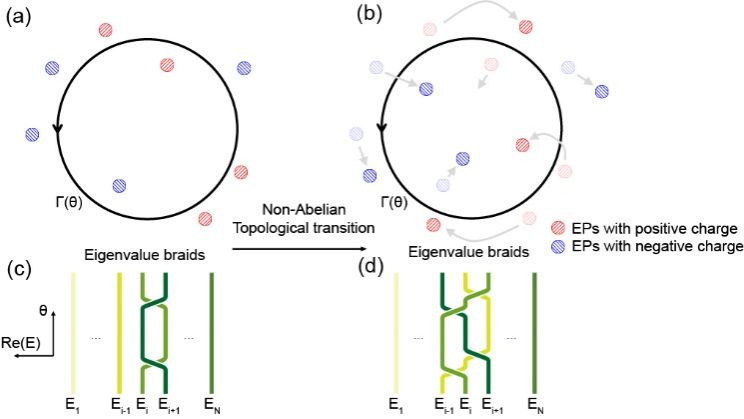
Fig 1:Non-Hermitian non-Abelian topological transition. (a) and (b) shows that the interplay between different types of exceptional points causes the non-Hermitian non-Abelian topological transition. (c) and (d) shows that the eigenvalue braids can be utilized to characterize this transition.
The second result is the first experimental observation of a new type of exceptional point—the Dirac exceptional point. Near this type of exceptional point, the eigenvalues are purely real and exhibit a linear dispersion relation with parameter changes, which is distinctly different from the square root dispersion law near typical exceptional points. The experimental results also demonstrate the degeneracy of eigenstates at the Dirac exceptional point, implying that this exceptional point is not a Hermitian degeneracy point. Notably, the purely real eigenvalues near this exceptional point offer the potential for achieving adiabatic evolution in non-Hermitian systems and avoiding dissipation introduced by imaginary eigenvalues. This work was featured in a commentary article titled "The first experimental observation of Dirac exceptional points" on the PHYS.ORG website.
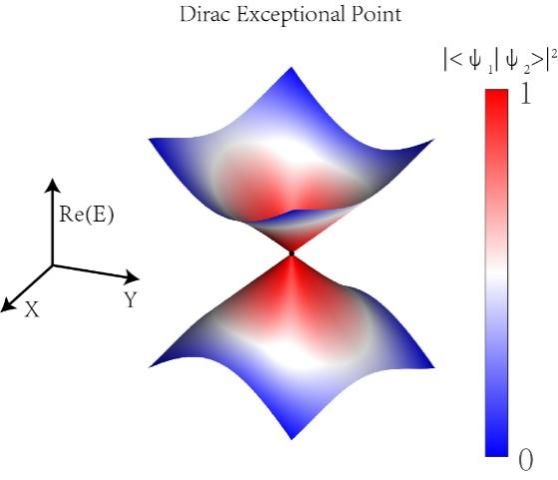
Fig 2:The Dirac exceptional point. The figure shows that eigenvalues near the Dirac exceptional point is purely real, and the eigenstates are degenerate at the Dirac exceptional point.
These two works lay the foundation for further researches in non-Hermitian physics in multi-level systems. They not only enable the investigation of novel topological phenomena in non-Hermitian settings, but also pave the way for applications in quantum control and non-reciprocal transmission through spectral engineering of non-Hermitian systems.
It is worth mentioning that the successful conduct of the above research is closely linked to the long-term efforts of Professor Ya Wang's team in the synthesis and preparation of high-quality diamond. Professor Wang's group successfully prepared diamond samples with a carbon-12 isotope purity as high as 99.999%, suppressing the nuclear spin bath noise that limits the quantum coherence time of single electron spins. The long-coherence time sample was a necessary condition for the experiments.
The co-first authors of the first work are PhD candidate Yunhan Wang and Dr. Yang Wu (now a Researcher under the Hundred Talents Program at Zhejiang University). The corresponding authors are Haiping Hu, Xing Rong, and Jiangfeng Du. The co-first authors of the second work are Yang Wu, Dongfanghao Zhu, and Yunhan Wang. The corresponding authors are Xing Rong and Jiangfeng Du.
The research was supported by the Ministry of Science and Technology of China, the National Natural Science Foundation of China, the Chinese Academy of Sciences, and Anhui Province.
Paper Links:
Work 1: https://www.nature.com/articles/s41565-025-01913-4
Work 2: https://doi.org/10.1103/PhysRevLett.134.153601
Commentary Article Link:
https://phys.org/news/2025-04-experimental-dirac-exceptional.html
(School of Physical Sciences, CAS Center for Excellence in Quantum Information and Quantum Physics, Department of Scientific Research)