


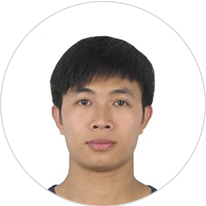
Song-Bo Zhang
songbozhang@ustc.edu.cn
Education
2012–2016 Ph.D. in Condensed Matter Physics, The University of Hong Kong
2008–2012 B.Sc. in Physics, Sun Yat-sen University
Experience
2023.12–Present Researcher, Hefei National Laboratory
2023.08–2023.12 Special researcher, University of Science and Technology of China
2021–2023 Postdoctoral researcher, University of Zurich
2017–2021 Postdoctoral researcher, University of Würzburg
Overview of Academic Research
Dr. Zhang’s research interest lies in condensed matter theory, with a focus on novel quantum phases such as topological insulators and quantum Hall systems. His work explores exotic quantum phenomena, quantum transport properties, and their potential applications in quantum computing and electronic devices. Representative research contributions include:
* Developed systematic theories for edge transport stability of topological insulators under magnetic fields, predicted the superresonant transport of surface electrons, and proposed perfect crossed Andreev reflection in the quantum Hall regime.
* Proposed new transport approaches for detecting higher-order topological phases, and designed quantum computation protocols based on higher-order topological superconductors.
* Established a systematic transport theory for Weyl semimetals under magnetic fields, predicting various exotic quantum phenomena in Weyl heterostructures.
* Predicted quantum phase transitions in non-Hermitian systems under many-body interactions, and skin effects under strong magnetic fields and interactions.
* Uncovered finite-momentum Cooper pairing and distinctive Coulomb drag effects in unconventional magnetic systems (including altermagnets).
* Predicted quantum phase transitions in non-Hermitian systems under many-body interactions, and skin effects under strong magnetic fields and interactions.
Research Directions:
Quantum transport and related condensed matter theory
Topological electronics at surfaces and interfaces
Open and non-equilibrium quantum systems
Topological quantum computation
Representative Publications
1. X. Zhu*, X. Huo*, S. Feng, S.B. Zhang†, S. Yang, H. Guo†, Design of altermagnetic models from spin clusters, Phys. Rev. Lett. 134, 166701 (2025). [Editors’ Suggestion]
2. H.J. Lin*, S.B. Zhang*, H.Z. Lu†, X.C. Xie, Coulomb drag in altermagnets, Phys. Rev. Lett. 134, 136301 (2025). [Editors’ Suggestion]
3. M. Hossain*, T. Cochran*, S.B. Zhang* et al., Topological excitonic insulator with tunable momentum order, Nature Physics (accepted, 2025).
4. S.B. Zhang†, L.H. Hu†, & T. Neupert, Finite-momentum Cooper pairing in proximitized altermagnets, Nature Commun. 15, 1801 (2024). [Featured Article]
5. M. Litskevich*, M. Hossain*, S.B. Zhang* et al., Boundary modes of a charge density wave state in a topological material, Nature Physics 20, 1254 (2024).
6. C. Li, B. Trauzettel, T. Neupert, & S.B. Zhang†, Enhancement of second-order non-Hermitian skin effect by magnetic fields, Phys. Rev. Lett. 131, 116601 (2023) [Editors’ Suggestion].
7. S.B. Zhang† et al., Emergent edge modes in shifted quasi-one-dimensional charge density waves, Phys. Rev. Lett. 130, 106203 (2023).
8. S.B. Zhang† et al. Super-resonant transport of topological surface states subjected to in-plane magnetic fields, Phys. Rev. Lett. 127, 076601 (2021).
9. C. Li†, S.B. Zhang†, J. Li, & B. Trauzettel, Higher-order Fabry-Pérot interferometer from topological hinge states, Phys. Rev. Lett. 127, 026803 (2021) [Cover Article].
10. S.B. Zhang†, W. Rui† et al., Topological and holonomic quantum computation based on second-order topological superconductors, Phys. Rev. Research 2, 043025 (2020).
11. S.B. Zhang & B. Trauzettel, Perfect crossed Andreev reflection in Dirac hybrid junctions in the quantum Hall regime, Phys. Rev. Lett. 122, 257701 (2019).
12. S.B. Zhang, J. Erdmenger, & B. Trauzettel, Chirality Josephson current due to a novel quantum anomaly in inversion-asymmetric Weyl semimetals, Phys. Rev. Lett. 121, 226604 (2018).