


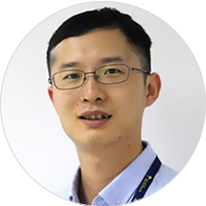
Yu He
hey@iqasz.cn
Education
2009-2015 Ph.D. in Atomic, Molecular, and Optical (AMO) Physics, University of Science and Technology of China (USTC)
2005-2009 Bachelor's Degree in AMO Physics, USTC
Experience
2023-Present Researcher, Hefei National Laboratory & Shenzhen International Quantum Academy
2020-2025 Researcher, Southern University of Science and Technology
2016-2020 Postdoctoral Senior Research Fellow, UNSW, Sydney
Overview of Academic Research
Yu He’s research field is quantum physics and quantum computation in silicon. My PhD thesis work has been focused on experimental quantum computation and quantum networks in photonics. My PhD supervisors are Prof. Chao-Yang Lu and Prof. Jian-Wei Pan. Then I became a postdoctoral research fellow at the Center of Excellence for Quantum Computation and Communication technology in Professor Michelle Y. Simmons’s group in UNSW, Sydney. During these four years in Sydney, I focused on silicon quantum computing with phosphorus donors, there are multiple works: demonstrating the first two qubit gate between phosphorus donors in silicon (Nature, 571, 371 (2019), a milestone work, listed by Medium as “Top 10 quantum computing experiments of 2019”), and I also joined the first atomic quantum integrated circuits for quantum simulation (Nature, 606, 694 (2022)). In totoal, I published 27 peer reviewed journal articles (2 Nature, 2 Nature Photonics, 2 Nature Nanotechnology, and 10 Physical Review letters), total 5000 citations. H-index 22.
Research Directions/Fields:
1.Donor spin qubits in silicon
2.Quantum simulation and build artificial materials using quantum dots
3.Single-electron quantum devices in silicon
Major Honors and Awards
2020 MIT Technology Review’s The Innovators Under 35
2015 The Special Award of Chair of Chinese Academy of Science, CAS
Representative Publications
1.Bluvstein, D. et al. Logical quantum processor based on reconfigurable atom arrays. Nature 626, 58–65 (2024).
2. Hu, G. et al. Single-Electron Spin Qubits in Silicon for Quantum Computing. SPJ Intelligent Computing, 4, 0115 (2025).
3. Zhang, S. et al. Acceptor-based qubit in silicon with tunable strain. Physical Review B, 107, 255301, (2023).
4. Kiczynski, M. et al. Engineering topological states in atom-based semiconductor quantum dots. Nature, 606,694 (2022).
5. Krauth, F. et al. Flopping-mode electric dipole spin resonance in phosphorus donor qubits in silicon. Phys. Rev. Appl., 17, 054006 (2022).
6. Keith, D. et al. Impact of charge noise on electron exchange interactions in semiconductors. npj Quantum Information. 8, 1-8 (2022).
7. Fricke, L. et al. Coherent control of a donor-molecule electron spin qubit in silicon. Nature Comms. 12, 3323 (2021).
8. He, Y. et al. A two-qubit gate between phosphorus donor electrons in silicon. Nature, 571, 371 (2019).
9. He, Y. et al. Time-bin-encoded boson sampling with a single-photon device. Physical Review Letters, 118, 190501 (2017).
10. Wang, H. et al. High-efficiency multiphoton boson sampling. Nature Photonics, 11, 361 (2017).
11. He, Y. et al. Quantum State Transfer from a Single Photon to a Distant Quantum-Dot Electron Spin. Physical Review Letters, 119, 60501 (2017).