


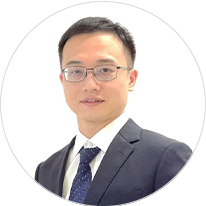
Yu‑Hao Deng
dengyh@ustc.edu.cn
Education
2023 Visiting Scholar, University of Chicago
2018-2023 Ph.D. in Physics, University of Science and Technology of China
2014-2018 Bachelor's Degree in Physics, School of the Gifted Young, University of Science and Technology of China
Experience
2024-Junoir Researcher, Hefei National Laboratory
2023-2024 Associate Research Fellow, University of Science and Technology of China Shanghai
Research Interest
My research focuses on addressing the following scientific question: How can we scale up quantum computers with quantum advantage and potential application value?Specifically, the research is carried out from the following directions:
1. Quantum Computational Advantage
Quantum computational advantage refers to the ability of quantum computers to solve computational problems that no classical computer can solve within a reasonable amount of time. In recent years, this has become an important milestone in the field of international quantum science and technology.
From the perspective of quantum physics, the problem of quantum computational advantage reveals the distinction between quantum physics and classical physics in terms of complexity. From the perspective of computer science, experiments on quantum computational advantage can provide evidence challenging the "Extended Church-Turing Thesis." Moreover, such experiments have become an important benchmark for assessing progress in near-term quantum computing devices and lay the technical groundwork for the development of fault-tolerant quantum computing.
We aim to answer three key questions:
(1) Can quantum computational advantage be achieved?
(2) Can quantum computational advantage be scaled up?
(3) Can quantum computational advantage have practical application value?
Through the "Jiuzhang" experiment, we were the first in the world to experimentally demonstrate quantum computational advantage using photonic quantum computing. Subsequently, we strengthened the photonic quantum computational advantage through a 114-photon Gaussian boson sampling experiment ("Jiuzhang 2.0"), addressing issues such as efficiency and programmability. In the 255-photon Gaussian boson sampling experiment ("Jiuzhang 3.0"), we tackled challenges related to photon collision detection, photon distinguishability, and classical spoofing, providing systematic and robust evidence for the most advanced photonic quantum computational advantage to date.
In terms of applications, my team and I demonstrated the use of "Jiuzhang" to accelerate solving certain graph problems. We also proved its robustness against efficiency issues, thermal noise, and photon distinguishability noise.
2. Scalable Fault-Tolerant Quantum Computers
To realize the promise of quantum computing on our daily life (e.g., Shor’s algorithm for breaking cryptography, quantum chemistry simulations, and materials physics simulations), or to fundamentally challenge the "Extended Church-Turing Thesis," quantum computers must not only surpass classical computers in solving specific problems at a certain scale but also extend quantum computational advantage in the asymptotic limit and run complex quantum algorithms. However, current quantum computing systems with relatively high constant error rates cannot achieve this. Therefore, it is necessary to develop scalable fault-tolerant quantum computers.
My team and I are working on addressing this challenge using physical systems based on optical tweezer arrays of atoms. Our research focuses on constructing large-scale optical tweezer atomic arrays, enhancing their engineering and control capabilities, surpassing the quantum error correction threshold, and exploring the comprehensive manipulation of large-scale logical qubits.
Major Honors and Awards
2023 Boeing Quantum Creator Prize
2023 Chinese Academy of Sciences Presidential Scholarship, Special Prize
2021 China’s Youth Award (team)
Representative Publications
•Y.-H. Deng et al, Gaussian Boson Sampling with Pseudo-Photon-Number Resolving Detectors and Quantum Computational Advantage, Phys. Rev. Lett. 131, 150601 (2023)
•Y.-H. Deng et al, Gaussian Boson Sampling with Pseudo-Photon-Number Resolving Detectors and Quantum Computational Advantage, Phys. Rev. Lett. 131, 150601 (2023)
•H.-S. Zhong*, H. Wang*, Y.-H. Deng* et al, Quantum computational advantage with photons, Science 370, 1460–1463 (2020)
•H.-S. Zhong*, Y.-H. Deng* et al, Phase-Programmable Gaussian Boson Sampling Using Stimulated Squeezed Light, Phys. Rev. Lett. 127, 180502 (2021)
•Y.-H. Deng et al, Quantum interference between light sources separated by 150 million kilometers, Phys. Rev. Lett. 123, 080401 (2019)
•J. Qin*, Y.-H. Deng* et al. Unconditional and Robust Quantum Metrological Advantage beyond N00N States, Phys. Rev. Lett. 130, 070801 (2023)
•Z.-C. Duan*, Y.-H. Deng* et al. Quantum beat between sunlight and single photons, Nano Lett. 2020, 20, 1, 152-157 (2019)
•H.-L. Huang et al. Compatibility of causal hidden-variable theories with a delayed-choice experiment, Phys. Rev. A 100, 012114 (2019)
•H. Wang et al. On-Demand Semiconductor Source of Entangled Photons which Simultaneously Has High Fidelity, Efficiency, and Indistinguishability, Phys. Rev. Lett. 122, 113602 (2019)