


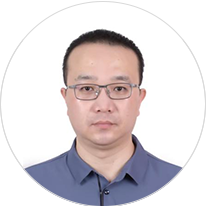
Hong Chang
changhong@ntsc.ac.cn
Education
2000-2005 Ph.D. in Optics, Shanxi University
1996-2000 Bachelor's Degree in Physics, Shanxi University
Experience
2022-Present Researcher/Director of Research Laboratory, Hefei National Laboratory
2007-Present Researcher/Deputy Director of Research Laboratory, National Time Service Center, Chinese Academy of Sciences
2005-2007 Postdoctoral Researcher, National Center for Scientific Research (CNRS), Institute of Optics, France
Overview of Academic Research
Prof. Chang’s research interest is the systematic research in optical clock development, applications, and precision measurement. His researches have driven the high-quality advancement of metrology research in China through a series of innovative initiatives.
His major achievements include:
*Developed the next-generation atomic clock at the National Time Service Center—the Strontium Optical Lattice Clock, and achieved the measurement of its absolute frequency. The data has been adopted internationally, enabling the National Time Service Center to independently trace the International Atomic Time (TAI) using optical clocks.
*As the Deputy Chief Designer for Space Time-Frequency and the Space Station Optical Clock Payload Leader, successfully led the team to develop the world’s first space-based optical clock, which entered orbit in 2022 with the Mengtian Experimental Module.It is now stationed on China’s space station, achieving for the first time laser cooling of alkaline earth metals in space.
*Successfully observed the Floquet quasi-particle interference effect on the optical clock platform and, for the first time, achieved the suppression of atomic tunneling in the optical lattice that does not depend on gravity. This technological breakthrough has provided new ideas and methods for the development of higher-performance space optical clocks and was awarded the 2022 "Top 10 Advances in Chinese Optics" Nomination Award.
Related achievements have been published in journals such as Physical Review Letters, Physical Review A, Physical Review Applied, Applied Physics Letters, and Metrologia.
Research Directions/Fields:
1.Development of strontium atomic optical lattice clocks
2.Development and application of space/transportable optical clocks
3.Precision measurement based on optical clocks
Major Honors and Awards
2025 Special Support Program for Innovation Leaders of the Three Qin Talents in Shaanxi Province
2023 Special government allowances of the State Council
2022 "Top 10 Advances in Chinese Optics" Nomination Award (Fundamental Research Category)
2022 Youth Scholar of the Chinese Academy of Sciences Regional Development
2022 Excellent Teacher of the Chinese Academy of Sciences Zhu Li Yuehua Award
2021 Youth Leader in Scientific and Technological Innovation in Shaanxi Province
2017 Outstanding Young Scientist in the Field of Time and Frequency in China
2013 Outstanding Contribution Award from the K.C Wong Western Scholars Program, Chinese Academy of Sciences
2010 Youth Scientific Star in Shaanxi Province
2009 Hundred Talent Program of the Chinese Academy of Sciences
Representative Publications
1.Xiao-Tong Lu, Feng Guo, Yan-Yan Liu, Jin Cao, Jia-An Li, Jing-Jing Xia, Qin-Fang Xu, Ben-Quan Lu, Ye-Bing Wang and Hong Chang*, NTSC SrII optical lattice clock with uncertainty of 2×10-18. Metrologia 62: 035007(2025).
2.Mo-Juan Yin, Xiao-Tong Lu, Ting Li, Jing-Jing Xia, Tao Wang, Xue-Feng Zhang, and Hong Chang,Floquet engineering Hz-level Rabi spectra in shallow optical lattice clock. Physical Review Letters 128: 073603(2022).
3.Xiao-Tong Lu, Tao Wang, Ting Li, Chi-Hua Zhou, Mo-Juan Yin, Ye-Bing Wang, Xue-Feng Zhang, Hong Chang. Doubly Modulated Optical Lattice Clock: Interference and Topology. Physical Review Letters 127: 033601(2021).
4.Guodong Zhao, Jian Xia, Yun Liu, Yongzhuang Zhou, Chihua Zhou, Feng Guo, Wenhai Wang, Dejing He, Min Feng, Ting Liang, Jie Ren, Qinfang Xu, Junwei Meng, Feng Gao, Yong Shen, Xiaotong Lu, Benquan Lu, Yebing Wang, Xiaohua Hu, Wei Tan, Hongxin Zou, Hong Chang. Laser Cooling Alkaline-earth Atoms for Optical Clock in Chinese Space Station. Chinese Physics Letters 42(6): 063701(2025).
5.Xiaotong Lu, Feng Guo, Yebing Wang, Qinfang Xu, Chihua Zhou, Jingjing Xia, Wenjun Wu and Hong Chang, Absolute frequency measurement of the 87Sr optical lattice clock at NTSC using international atomic time. Metrologia 60: 015008(2023).
6.Wei Tan, Wei-Xin Liu, Ying-Xin Chen, Chi-Hua Zhou, Guo-Dong Zhao, Hong Chang*, Jun Dai,†, and Tao Wang‡, Realization of Landau-Zener Rabi oscillations on an optical lattice clock. PHYSICAL REVIEW A 111, 033102(2025).
7.Xiao-Tong Lu , Feng Guo, Yan-Yan Liu, Jing-Jing Xia, Guo-Dong Zhao, Ying-Xin Chen, Ye-Bing Wang, Ben-Quan Lu* and Hong Chang†, Determining the lifetime of the 5s5p3Po0 metastable state in 87Sr from the electric dipole matrix element. PHYSICAL REVIEW APPLIED 21, 024042(2024).
8.Xiao-Tong Lu , Feng Guo, Jing-Jing Xia , Yan-Yan Liu, Ben-Quan Lu, and Hong Chang*, Stability analysis in an optical lattice clock using the four-path measurement. PHYSICAL REVIEW A 109, 023111 (2024)
9.Xiaotong Lu, Feng Guo, Yebing Wang, Min Feng, Ting Liang, Benquan Lu, and Hong Chang. MF-dependent hyperfine-induced 5s5p 3P0 –5s2 1S0 clock transition rates in an external magnetic field for 87Sr. Physical Review A. 108(1):012820 (2023).
10.Benquan Lu, Xiaotong Lu, Jiguang Li and Hong Chang, Reconciliation of Theoretical Lifetimes of the 5s5p 3P2 Metastable State for 88Sr with Measurement: The Role of the Blackbody Radiation Induced Decay. Chinese Physical Letters 39,073201(2022)
11.Mo-Juan Yin, Tao Wang, Xiao-Tong Lu, Ting Li, Ye-Bing Wang, Xue-Feng Zhang, Wei Dong Li, Augusto Smerzi and Hong Chang. Rabi spectroscopy and sentivity of a floquet engineered optical lattice clock. Chinese Physics Letters, 38(7), 073201(2021).
12.Qinfang Xu, Xiaotong Lu, Jingjing Xia, Yebing Wang and Hong Chang. Measuring the probe Stark shift by frequency modulation spectroscopy in an 87Sr optical lattice clock. Applied Physics Letters 119(10):101105(2021).
13.Xiaotong Lu, Chihua Zhou, Ting Li, Yebing Wang, and Hong Chang. Synchronous frequency comparison beyond the Dick limit based on dual-excitation spectrum in an optical lattice clock. Applied Physics Letters, 117, 231101(2020).
14.Qiang Zhang, Chihua Zhou, Junwei Meng, Feng Guo and Hong Chang. Parallel quantum random number generation based on spontaneous emission of alkaline earth[J]. Applied Physics Express. 13(1),012015(2020).
15.Qiang Zhang, Dehuan Kong, Yebing Wang, Hongxin Zou, and Hong CHANG. Dual-entropy-source quantum random number generation based on spontaneous emission. Optics Letters,45(2):304-307(2020).